"Zack Snyder's Justice League": Professional artist reflects on vision, direction, and significance
- Sam Tarter
- Apr 16, 2021
- 20 min read

Author’s Note: With the continuing decline of new and interesting movies being released in theaters due to the pandemic, I have currently hit a road block in terms of content for movie reviews. To continue writing for my blog, however, I have come up with a solution. What you are about to read is the first entry in a series I call “Conversations and Passions,” in which I sit down with a person or group of people—a friend, teacher, peer, family member or even stranger—and we discuss a particular movie, film series, or aspect of filmmaking that relates to their passion. For this first entry, I convinced my dear friend, former art teacher and current humanities teacher Mr. Sean Powers to watch the 2017 cut of “Justice League” and the newly released four-hour long “Zack Snyder’s Justice League” aka The Snyder Cut. In what became a 35-minute long interview, Powers and I discussed the comparisons between the two films, the importance of tone, genre, theme, and colorization, and the importance of artistic integrity.
Sam Tarter (ST): You watched both versions of the movie—the 2017 and the newly released Snyder Cut—what were your initial thoughts coming out of that experience?
Sean Powers (SP): That's a loaded question. There's a lot of ways that I can answer that. Let me start off by saying, I don't really like superhero movies. That is not a genre of film that I'm going to go out of my way to watch, and I don't really like them for a variety of different reasons, and I will explain those things to you. Now just to be clear, this is my personal preference. I'm not saying that this is objectively not a good genre of film, but personally, spiritually and philosophically, I'm not into the idea of a hero and the personification of heroes, and that comes from my own Christian spirituality. Yeah. I think even and then put it Christianity. So a lot of people think Jesus is basically this superhero, right? But the Gospels do not depict Jesus so much as a superhero but as a suffering servant—who does have a comic book ending when he rises from the dead and all of humanity with him—but it's not necessarily heroic. So I would naturally, personally be drawn more towards maybe an anti-hero, which certainly, these movies have a bunch of different anti heroes in them. Like I think of the X-Men, right? Yeah. They’re all anti-heroes. And you could even argue that "well, all these heroes are sort of anti heroes," like Bruce Wayne.
ST: Yeah, like how in these movies he kills people but deep down he feels remorse for it.
SP: Yes. And like The Flash he's, you know, his motivation comes from his father who's in prison. And what's the robot guy's name... is it Cyborg? Cyborg? Yeah, like, you know, these are sort of anti-hero people. So that's not a great reason as to why I don’t like these films, but it’s one of them. The other reason why I don't really like them is—and this is my own personal preference—I enjoy more dialogue, and there's not a ton of dialogue in any of these movies. I mean, relatively, if you compare the percentage of dialogue to the length of the movie versus say some other film, the dialogue is very minimal, and that kind of bores me, because I enjoy dialogue in film.
ST: Yeah, for sure.
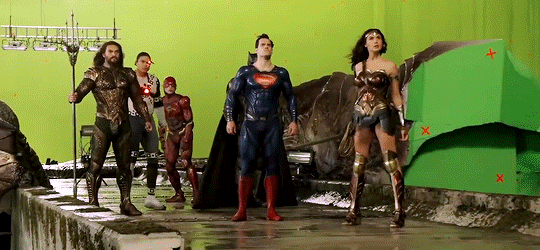
SP: I also am not a big fan in general of CGI, and I know that that's actually a huge draw of these films, and that a big platform for these films is ‘let's see what we can do with CGI’. And, personally, I just don't really care about CGI. You know, there's other ways to do special effects, and those are somewhat more interesting to me. And I'm also not terribly into special effects in general. But that is my own personal interest in style. All of those things being said, so what did I think of these films? I thought they were okay, and to be honest, as an outsider who doesn't know the drama and the story of making the first cut, and then the Snyder Cut… this is gonna sound offensive or totally different from you, but… I didn't think they were too terribly different, really, in terms of the story.
ST: Oh, yeah, and that’s expected in a lot of ways with it being a “director’s cut.”
SP: Yeah, and I was kind of bummed by that with the Snyder cut. I'm just like, ‘some of these scenes are exactly the same, just with a different filter.’ Yeah, it kind of felt that... he was like, "Oh, this is totally different, so much better." And I'm like "How? How is that?’" Maybe that's the question: how is—or simply is—The Snyder Cut better? Is it better? I'd say in some ways, yes, and in some ways no.
ST: Really?
SP: Yeah, I mean, I liked different parts of it, but once again I'm not involved in the culture and the back and forth and the dialogue and the blogging (*Powers gestures towards me*) that's going on about why this is better. So ways in which it was better: soundtrack. Very nice! I did like the music, especially in the first third of the movie, when introducing these characters. There's great soundtracks, both explicit when they're introducing the character, but also in the background that’s going on. In fact, I went to my Spotify playlist, and I looked up ‘Snyder cut soundtrack’, and it's just such a great soundtrack.

ST: So are you referring to the score—like the music that you hear in the background? But then you're also talking about just the songs that he put in in there… like in the Aquaman scene when he's about to jump into the ocean, or when The Flash is saving that girl from the car crash? You're talking about all of it?
SP: Yes, all of it. It seemed less gimmicky. It seemed more... maybe just more nuanced. And, again, I'm not a musician so I can't say how and why that is per se. But it does seem just a little bit more intentional and less stock, like, "Oh, Superman is in here so we have to put in his music." This seems a little bit more reverential, maybe… yeah, maybe that's the word that I would say: The Snyder Cut’s music seems more reverential to the characters and more idiosyncratic—in a good way—of their personalities. So I liked that. I felt that it fostered more character development through the music, which is cool.
ST: Yeah, I agree. A big complaint with the theatrical release was that Danny Elfman—a very great and renowned composer—he kind of rushed the score and recycled old material. He composed the score for the original Batman in ‘89, and despite the fact that Batman and Superman had these totally different, unique themes and scores in “Man of Steel” and “Batman vs Superman,” he just reused his old Batman theme and threw in John William’s Superman theme. The music—and the movie as a whole—was just this complete departure, because before we had this music that was darker and serious, and Elfman’s score was just too nostalgic. It just didn’t fit.
SP: Yeah. And that's actually one of the things I would say also, in general about the Snyder Cut is that... the Snyder Cut is sort of sub-grandising and celebrating what the series has been but less so than the 2017 version which I appreciate. The Snyder Cut seems to have more of a mission, rather than less of a celebration or being like, “Look, this is the fifth film, this is a great achievement and everybody's together now.” There is some of that self-celebration, but I think the mission felt a little bit more intentional, serious, and against that sort of reverential one… mainly because of music, too, but also because of the filtering that's going on. For lack of a better word, its a darker film, and I don't know that in terms of mood but in terms of lighting…

ST: Yeah, overall it just looks darker and more serious. The color contrast isn’t pulled up so high that it gives you a headache, and it’s just easier to look at.
SP: And any time in the world of art when you’re going to do that it’s going to become more serious.
Overall, I think my main problem with the movie is like… why did you have to do four hours? The biggest question I have from this is why is this film four hours long? It’s insane.
ST: I totally agree… its the same with me. I watched the movie and immediately I thought, “That was really good, but there's a perfect version of that movie that's only three hours long. Like you could have cut out an hour, maybe a half hour, and it could have been the same thing. I just thought there were a lot of deleted scenes that were there because Snyder was like, “I want to do it all!”
SP: There’s only so much slow motion of The Flash that I can watch (*laughter*) until I’m like, “I dont care.” Honest to God, at the end of the movie when The Flash time travels I thought, “He is going even slower.” And he probably did that because they've already had seven different slow motions of him. And I'm like, it's cool, but I've seen a half hour of him running around so I just don't need that. And I am critical of movies that become too long that I can't watch them in onr sitting. And I know that this gets released on HBO Max and that people are streaming this at home, and it’s intended to be watched through on your own time.
ST: Yeah, and that’s why it has the chapter sections to help with that so you can take a break.

SP: And this is my big problem with The Snyder Cut: if you want it to be a four part series, make it a four part series. If you want it to be a film, a movie, make it max two and a half hours. I'm not gonna sit down and keep watching a movie for that long. I will watch a four part series, HBO Max has tons of those four part series, and I’ve watched them all. I’ll watch an hour of one at a time and I’ll watch it for four days. I'm thinking of Chernobyl. I just watched that last week... I watched it two summers ago and I was like, “That is an amazing series.” I loved it, so I watched it again over four or five nights.So, The SNyder Cut, I think that it could have been that. I would have loved to see that. And I know he has the chapters in there, but if you're not going to have them be separate individual things…
ST: Yeah, it just feels kinda cheap.
SP: Yeah, it's like, “I can get away with having a long film by having these chapters in it.” I think that is exploitative.
ST: So I believe it was supposed to be like four different episodes when they originally announced it. It was supposed to be a mini series. But then they went back and looked at the contracts, and all the actors signed on for a movie. And if they were to change it into a TV series, they would have to go back and have everybody re-sign, and then it would just cost more to stretch it out over a month and continuing to market it.
SP: And I think that's a big mistake of the Snyder cut, and I was disappointed by that, particularly because it just felt a little excessive.
ST: I totally agree with that.
So let’s talk about more character development. What did you think of Cyborg? Because that was probably the biggest change from the 2017 version into this one. Like, Cyborg is an actual character, versus in that other one he was a plot device. So what were your thoughts on his story?

SP: I liked it, and here when I say I felt that I like the Snyder Cut: it had a greater sense of mission. That implies the question, well, what is their mission? Obviously, it's to save earth from… Steppenwolf was it?
ST: Yeah, Steppenwolf, DeSaad, Darkseid. Planet Apokolips or something like that.
SP: Right… so that's the obvious mission, but I think the movie is actually about something else. I think the movie is about teamwork. I mean, why else do you have a film about five superheroes when the point of a superhero is to not need anybody besides oneself? This is where I think this is actually a nice film. It's saying even superheroes need help. What better message to send in a pandemic world where everybody is severed and isolated from one another? What better message to send than we all need to be working together to defeat a common enemy. It's a beautiful message. And so the more characters that you have in that, the richer the message. And you have people that are human beings, and you have people that are nonhumans that have superhuman powers. You have people that are humans that have superhuman powers, and then you have humans that have robotic, mechanical powers. So you have humanity touching into the supernatural humanity. The supernatural being maybe masked by humanity, and you have humanity integrating itself into machinery and vice versa. There's questions about “How do we experience our own humanity?” And each one of those superheroes experiences that humanity a different way. And some of them experienced it more personally than others.... they sort of have more understandings of what humanity means and in our age, I think that is really powerful and it makes the message richer. I think it also makes the message of teamwork richer as well.
ST: Absolutely… you know that’s great. I never thought about the interconnecting and differentiating views of humanity for each team member.
SP: Right. To be political, my guess is Cyborg becomes a character to include a minority in the team. Which I think is politically speaking to be contemporary, I think is a great, great idea, and a great message. It does sort of feel somewhat gimmicky. Like we're trying to be relevant and politically correct. That's sort of the vibe I get. But I quickly moved past it because I did like, the character of Cyborg.
ST: Likewise. A lot of people were like, “Oh, you just had Cyborg in the movie to be the token black guy,” but that's not really even the case.
SP: I think it actually is the case, but it works well.

ST: Yeah, exactly. It’s done right and it’s not forced diversity. And you know, Cyborg was only the first minority member of the team. We saw Martian Manhunter show up in the middle and at the end... obviously he is a green alien, but his human persona is a Black general. And we were supposed to get or eventually see John Stewart on the team, who is probably the most famous black superhero for DC, but then that didn't happen. So the team was supposed to be and become more diverse with later films. But Cyborg was the first one, which is cool. And I liked it too, because, after Chadwick Boseman passed away last year, I thought it was really good to have a very prominent Black superhero again, especially one that's treated with such respect and reverence.
SP: I did appreciate—from a Christian spirituality perspective—the sacrifice of his father, for not just his son, but for the team. That was very cool. I appreciated that as sort loss for Cyborg when he dies. And this is actually why I have critiques of superheroes: they always survive. There's something to be said about loss and the power that can come from loss is as powerful as constantly winning. So I go with Superman, for instance. Superman is dead and then he comes back to life. Also, as an outsider, I didn't really… fully understand how he came back to life.
ST: I agree. That was also a huge complaint of the first one… it was like, “Oh, we will just throw the magic box in the water and he can come back to life.” And I was like, “Okay, maybe The Snyder Cut will explain it.” And it did, but it also didn't explain it. It was like they tried to, but then they didn't fully succeed in explaining it.
SP: And then he just appears and I'm like, “Yeah, okay, so did The Flash reverse the box going into the water? Did the box even touch?” And this is like hour three! That might be excessive… it might’ve been hour two and a half.
And this is a big critique: I simultaneously liked how The Snyder Cut. I felt like they set up the characters—each individual character—better than the original one, but I also think that each character set up was too long.

ST: And that's the thing, it’s once again, studio interference from Warner Brothers: they're rushing to get head to head with Marvel, and they didn't do the solo movies before. So they had to make this big Justice League movie and establish the characters at the same time.So in a way, I agree… four hours is excessive, but it's also necessary in a way. But at the same time, it's just… it's so long. Too damn long.
So, to continue talking about Superman… in the previous movie, he's only in that red and blue suit, but this one isn't: it’s a black and silver suit. Did you like that? And do you think it was unnecessary? Because, personally, I thought it was cool to have a new suit, and I’m sure it was cool for the older comics fans who were fans of that suit in the 1980s. But it was also kind of like, “Okay, new costume… so what?” He didn’t even acknowledge that it was a black suit. Nobody on the team even said anything to him about it. It was just kind of there to look cool.
SP: I thought—that's a great question by the way—I think it makes sense for that kind of movie. I mean, everything in that movie is relatively monochromatic and dark. You know… what I think would have made a lot of sense was if Wonder Woman and The Flash also become monochromatic as well. Aquaman kind of is.
ST: And Cyborg... he’s just pure metallic silver.
SP: Batman is monochromatic, obviously. But Superman gets this monochromatic new costume. Partially that is, I think for the history and culture of the fans. That's cool. And I think that actually makes sense. It kind of fits the style of the film. And I liked that. But Diana and Barry… they dont change their fashion. I was like, “Oh, well, why did Superman get a new fashion? Why does he get a new suit but nobody else does?” And someone might say, “Well, it's because he came back to life.” Yeah, okay, that's great, that works. But if he's singled out in that way, then does this movie become about him? Maybe it is about Superman. Well, if it's about Superman, why am I not learning anything about Superman until hour two and a half? And yeah there's these scenes with Lois Lane and his mom, but they seem sort of tacked on. The narrative arc seems very, very slow to get to Superman and Superman being super important. The story progression on that should have been a little bit more steep.
ST: I assume you haven't seen the two movies before this? Man of Steel and Batman vs Superman? So thats a problem in and of itself. If you're a fan, it would seem that each movie… it'll lead up to this one. But at the same time, if you're making a movie, you kind of want it to stand on its own. You don't want to rely on something that came before it, or something that's going to come next, especially for casual fans or wider audiences.
SP: Well, you do have permission to do that, but I would say—and I can probably infer what happened from those movies from the scenes that happened, so I don't feel like I was left in the dark—it's just too slow of a development.
ST: Yeah, like I'm all for Superman. He's so prominent and powerful and cool to see on screen, but why did it take so long for him to come into the story?
SP: Yeah, so that's my opinions. I like the red and blue cape outfit. I think that's nice. To answer your point. I think he (Snyder) probably could have made it with his traditional blue and red outfit. I think that probably… ultimately would have been a better choice. Just tone down the color, even more than they did in the 2017 version. Turn it down even more, and it would still fit in.

ST: I totally agree. We discussed this earlier with Cyborg, but what were your thoughts on the underlying theme of fatherhood and parentage as a whole (in the relationship with Cyborg and his father and the loss of his mother, The Flash with his Dad in prison, Aquaman living up to the legacy of his mother and the disapproval of having a human father, Batman and Superman carrying on the legacy of their deceased parents). Did you think this was a strong choice to make these godlike beings seem more human and realistic?
SP: Disjointed or absent parentage seems to be a common trope within superhero movies. Without having any background in the genre, I can't say this for certain, but I would suspect that the concept of a superhero mimics that of the god-men of Classical mythology such as Hercules. I would not say that the absence of a set of parents make superheroes seem more realistic, but it does make them seem in a way more relatable, more vulnerable. This seems to serve two purposes: first, it evokes pathos, drawing us more emotionally-close to the characters; secondly it creates drama. The superheros are powerful, but not all powerful. We would expect that they would triumph in a battle, but we are never totally sure going into it.
ST: So, I’m gonna turn the tables on you and ask you a humanities question. So probably one of the biggest complaints about the 2017 version was the really shitty CGI: it was way too bright, the color was all over the place, but The Snyder Cut was a bit more toned down, and it was a little easier on the eyes, right? Also, this one has a taller aspect ratio with a bigger frame. So to quote Thomas Aquinas, “Was it was it beautiful?” Or, “Was it like pleasing to the eyes?” What would you say to that?
SP: That’s an interesting question. So, at the beginning of The Snyder Cut it said something like, “To preserve the director’s intent, this film will be presented in a certain aspect ratio.” The aspect ratio he used… is that traditional or common?
ST: Yeah… so they kept it in what’s called the 4:3 aspect ratio to “preserve Zack Snyder’s vision”. So on typical movie screens, it's not 4:3, its the same width but a lot shorter. But on an IMAX screen—which is a lot taller—this is what the movie would’ve looked like… it would’ve taken up the whole screen. That so he filmed it with IMAX cameras so that eventually they could have shown it on a big IMAX screen. Sadly, they never got around to it because of everything that happened behind the scenes. But he wanted to show it this way because it looks better and frames the heroes in a much grander scale. So that’s why you have the black bars on the sides instead of on top and bottom… because most TVs arent big enough or “box shaped” to showcase something in 4:3.

SP: Yeah… that was actually really cool, and the black bars didn’t really bother me. You don't really pay attention to it once it’s started.
ST: It’s a beautiful film no matter what. It’s just shot and edited and visually it looks great. In terms of CGI, though, were you happy that some of it was done away with from the earlier version… all the ugly color grading and the bad Superman CGI, and all of that?
SP: You know, I said this earlier but, I don't really like CGI. But isn't every film that you ever see—even if it's not a superhero film—there's going to be CGI, and I get that. But the less of it there is, the more I appreciate the film. So which use of CGI is better? I would kind of say both. There's an excessive use of it… if I'm asked which one is better? Sure, The Snyder Cut is better, and that's probably because of the harmonious use of color. And you say, “Well, it's not as luminous of coloring. Right? Because some would argue… if we put this into the comparisons of art history, the 2017 cut is Renaissance, and that’s very obvious: it's very colorful, it's very bright, and it clearly shows what's happening. But The Snyder Cut is Baroque: you don't see everything that's happening, it's not all clear, but it does convey a brooding emotion, more so than the 2017 cut, which is kind of saying, “Look at all these special effects.” Frankly, The Snyder Cut is also saying, “Look at all these special effects. Part of the nature of superhero films—comic book films— is, “Let's see what we can do with special effects on this big of a platform.” So the question becomes, “Do you like renaissance art or do you like Baroque art?” Well, I personally Baroque better so i'm drawn more towards The Snyder Cut, and thankfully because of the nature of superhero films and what they're trying to do, and how they’re trying to convey emotion from the viewer, I would say The Snyder Cut is probably more effective.
ST: For sure.
SP: I would compare it to… in the first decade of the 2000s when Batman Begins came out: that was the most grueling and monochromatic of all the Batman films… no longer did Batman have yellow in his costume, it was all black. And Christopher Nolan… he's as much of a philosopher as he is a film director and producer, and The Snyder Cut shows that in the same way. Snyder and Nolan are friends and partners right? Because the work in this film definitely reflects that relationship and that friendship.

ST: Recently, like how fans fought to “Release The Snyder Cut,” fans are asking for WB to Restore the SnyderVerse (aka continue the story after this movie). For the fans sake, do you hope that this happens? Would you like to see Snyder’s vision and this different direction for the characters continue?
SP: Again, I could not quite say. I am not knowledgeable of Snyder's fan-base. I suppose if the fan's want it then the man ought to give the people what they want, right? To your second question, I am indifferent. My answer comes from my general disregard of superhero movies. That said, I would prefer to watch Snyder's darker, brooding style than the style of other superhero films.
ST: Yeah… so, last question: were you shocked at all when I told you the story about what happened behind the scenes? Because when I saw that Vanity Fair article, I was thinking, “That's pretty rare... that never really happens in the film industry.” So is there anything in the art world that you would kind of compare it to, or anything that kind of struck a chord with you. Anything in terms of taking the director or artist’s vision and disregarding it for making a profit?
SP: Happens all the time. It happens all the time—in architecture, art, music, film—this literally happens all the time. it happens with people's permission and people's acknowledging that this has become something different… but that is the nature of art and business. The relationship between art and business is constantly a tenuous one. Some of the best works of art come when a producer gives the director and the writer money and says, “Do whatever you want to do,” and that rarely happens. It never happens with big box office films with high production values such as these because so many people are involved. The phrase in the art world… we say, “Art by committee.”It's essentially saying, “No good art comes from committee.” Like Miles Davis’ Kind of Blue… one of the greatest jazz albums ever. It comes from Miles Davis and his ideas shared with his friends. Any of these big musical albums nowadays come from committee, and they aren’t that great. The bigger the hollywood film, the more voices that are said. If you think about how do a lot of film and TV shows make a lot of money? On the side product placement. For instance: so lets say I'm gonna make a movie, and Apple is giving us $10 million to have apple products in our TV show, so we have to make sure that we're showing plenty of shots with an apple product in the film. Also, let’s say I'm gonna get John Williams on board to do the score. That’s great, but John Williams isn't gonna do it unless he gets a certain number of minutes of his score in the film. Well maybe I actually want a lot of silence in my film, so you're not going to be able to get John Williams, so do you want to spend the time and the money and the uncertainty to find somebody that's going to do what you want to do, even though they're not going to produce maybe as good of quality as something john Williams would do with a sound? Well then you got to find somebody to do that. That's going to take a long time. What they're going to produce you're not so sure of, but you know John Williams is going to do a great job. You don't know if so and so is going to do a good job. There are a lot of factors when it comes to filmmaking, and a lot of jobs and money are on the line. So is it surprising something like this happened? Or that something as disgraced as the 2017 cut happened? Is it surprising to me? Not at all. And people were outraged because this isn't as good of a movie as they thought it would be… that happens all the time.
To your point, it is kind of a typical that somebody is like, “No, you know what? This is embarrassing. I'm going to redo this. I'm gonna have people spend $70 million to do this over again.” It's not surprising because I guess HBO figures, “Hey, we're gonna make a profit.” So it's not terribly surprising. What is surprising is that enough, people said, “This is terrible, we want a redo,” and that the director and producers are like, “Yep, let's do a redo.” That doesn't happen a whole lot. Most people—most artists—are like, “I'm done with this project. It was great. I'm moving on with my life because I have something else I want to focus on.” Clearly, this meant a lot to Snyder, and I think maybe his daughter had something to do with it, so this is a great way to honor her. It was something that he was interested in, clearly passionate about. So he went back to the drawing board, and that is noble and applaudable. It doesn't happen a whole lot when people go back to old projects—particularly projects that a lot of people have said were a failure—and tries to make them right. That is noble. So in some ways, it's not totally unique, but it is applaudible that it actually happened.




Comments