“Joker” is one of the year’s best film; DC's best movie to date
- Sam Tarter
- Nov 23, 2019
- 5 min read
Updated: Jan 27, 2020
If three years ago you would have told me that the director of “The Hangover” had made the best movie of 2019, I would have laughed in your face. If you had told me it was also a movie about the most famous Batman villain, The Joker, I would’ve said you were as crazy as the character himself.
But over a month since I first saw the Todd Phillips’ directed character study, I can still safely say that “Joker” is the best film of the year, subverting mine and many others expectations as being better than Marvel’s climactic cinematic epic that was “Endgame”.
Where this small-scale, emotionally driven drama prospers amongst the action heavy and world-ending feats of other superhero movies is its emphasis on setting and character. 1981 Gotham City is divided both figuratively and literally: with the rich, Gotham elite full of upper-class businessmen and their luxurious houses, they look down upon the rest of the city with dilapidated housing and trash overflowing into the streets (both in bags and in ratty clothing).
At the center of this crime ridden city is the film’s protagonist (or should we say antagonist?), Arthur Fleck. Each problem and flaw that Gotham city has, Arthur is a victim of: he is beaten up in the streets by misguided teens, forbidden from receiving his necessary medication and therapy due to budget cuts, and forced to be the soul caretaker and provider for his mentally and physically ailing mother. With the overwhelming amount of misfortunes inflicted upon him by the city and the people in it, Arthur must also deal with personal struggles and unlucky circumstances: he suffers from a condition of uncontrollable laughter (which often takes effect at the most inopportune times), is delusional, and unwelcome and unwanted by everyone around him. Arthur is completely and utterly alone in every place he goes.
As the film opens, we see just how hard Arthur’s life can be, and the audience comes to understand just how hopeless he has become. Life continues to beat him down relentlessly, and despite his abnormal demeanor and off-putting personality, it is made clear that he means well, and that his unfortunate life is not entirely his fault. _________________________________________________________________________
Many have likened this Joker origin to another in comic media: Alan Moore’s “The Killing Joke”. A graphic novel depicting the unfortunate life of a stand up comedian prior to his transformation as Gotham’s most influential villain, it also details a realistic and uneasy process of an unlucky man becoming something truly awful. A quote from the novel’s first section describes the Joker’s tragic mental state as such.
“Even the sanest man can be driven to lunacy! All it takes is one bad day. That’s how far the world is from where I am. Just one bad day.”
But for Arthur, he has had nothing but bad days. All of the pent up rage and disgust he has for the city he is stuck in, combined with the hopelessness of being abandoned by society and seen as if you don’t exist, is fully released on a janky subway train. Having been fired from his job and now being harassed and beaten by three wall street men, Arthur unloads his gun on them, first in self-defense, then with intent and pleasure. The film’s slow but powerful build up to Arthur’s first of many murders will leave the viewer in shock but also in grief. Having come this far with Arthur, you fully understand why he is taking action, but are disappointed to see him do it in such a horrific way.
Throughout the entire film, I was constantly questioning whether or not I should root for Arthur or be appalled at his actions. Whether I should be happy that he is taking enjoyment in the crimes and murders he commits, or wanting to recede further back into my chair and look on with disgust. Whether I should be glad he is finally getting something out of a hard and unlucky life, or disappointed that he is choosing such a vulgar method of standing up for himself. The best villains are those we can both fear and empathize with, and I applaud Phoenix’s performance and Phillips’ screenplay for giving us a character that terrifies me with his chilling laugh and horrific actions, while also making me feel sorrow for a broken and realistically tragic man.
To further make Arthur a terrifying and powerful presence, and to make his situation and his story even more uncomfortable, is the score by Icelandic cellist and composer Hildur Guðnadóttir. Her use of the cello and other string instruments provides an eerie and overwhelming sensation of dread and fear for Arthur’s actions. Some songs provide a tune similar to broken strings, paralleling Arthur’s broken mental state. At the film’s climax, Arthur smears blood across his face in the form of a smile, dancing for the crowd of protestors and fully embracing his position as a symbol for the oppressed and the disenfranchised. Guðnadóttir’s score rises to a prominent and heroic fashion, similar to a superhero’s theme taking over a scene when the hero saves the day. But instead of praising the protagonist, Joker’s theme insinuates fear and grief in the audience, and once again makes you question your alliance to such a powerful and frightening figure.
The cinematography, done by Lawrence Sher and heavily influenced by Phillips, does an impressive job of making the city feel overbearing on Arthur, and making certain shots naturally off-putting and off-center to give a sense of uneasiness. The set design also assists in providing a dreary, hopeless, and grime covered Gotham, and perfectly captures the setting of an early 80’s crime film by Martin Scorcese (which this film takes many other inspirations from his filmography, especially 1976’s “Taxi Driver” and 1982’s “The King of Comedy”).
_________________________________________________________________________
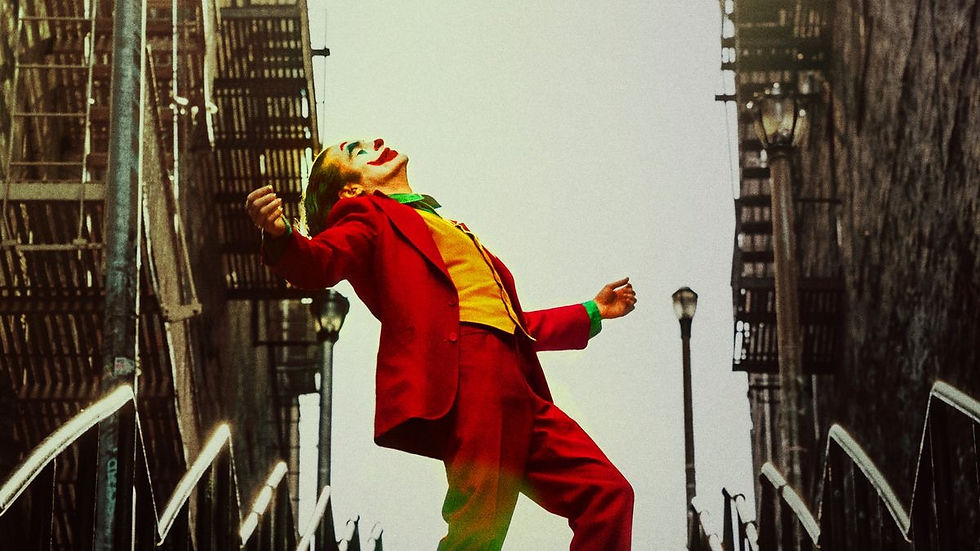
“Joker” is not only a career best for Phoenix, but for Todd Phillips as well. I would have never expected such impressive work from him given his previous films, and this movie definitely deserves its high praise, billion dollar box office take-in, and inevitable wins at next year’s Academy Awards. Phillips fills his masterpiece with subtle details and hints making you guess what is real and what is in Arthur’s deranged mind, allowing the audience to interpret the film in their own way, which the best films always do. Symbolism is prevalent in the film as well, my favorite being the set piece of the elongated staircase leading to Arthur’s apartment. In the film’s beginning, Arthur struggles to ascend the staircase as he walks up with his head down, having horrible posture and coming off as insecure and miserable. This walk up the staircase parallels Arthur’s struggle to fit in among society and to be seen as normal, and is in strong contrast towards the film’s end. Having donned his red suit, green-dyed hair, and white, red, and blue clown makeup, Arthur dances down the staircase with all the confidence in the world, finally embracing who he has become and accepting his descent into madness.
Movies don’t get much better than this.
Conclusion: “Joker” is not an easy or always enjoyable watch, but definitely a powerful, impressive, and awards-worthy work of art. It mixes the realistic, relatable and frighteningly-real story of a broken man being abandoned by society, with an art-house style character study and depiction of mental illness. Both uncomfortable and enjoyable, this film will be talked about for years to come, and is a career best for everyone involved.
Rating: 9/10



Comments